
Last reviewed: May 2026.
GroupCal sells itself as “the WhatsApp for calendars”: enter your phone number, invite people by SMS or link, and you have a shared calendar in seconds. It really is that simple at the core. But the app has changed a lot since its 2019 launch — especially around pricing and member limits. If you’re thinking of using GroupCal for a club, team, or community group in 2026, there are a few things worth knowing.
Table of Contents
- What is GroupCal?
- Features and pricing at a glance
- Where GroupCal shines
- Where it falls short for clubs and teams
- GroupCal and GDPR
- Alternatives to GroupCal
- Bottom line
What is GroupCal?
GroupCal is a shared calendar app from 24me Ltd., headquartered in Israel, first released in late 2019. Sign-up is phone-number-based, just like WhatsApp. Invitations go out via SMS or invite link, and every new event shows up instantly for everyone.
In 2022, GroupCal pivoted from a pure consumer tool to a SaaS platform — with tiered pricing, public Channels (one-way calendars), and features targeted at communities, coaches, churches, and creators. In 2025 the iOS app got a full “Liquid Glass” redesign for iOS 26, plus Apple Intelligence support for natural-language event creation.
Features and pricing at a glance
- Platforms: native iOS and Android apps, a web app, and an installable PWA for Windows and Mac. No traditional desktop app.
- Pricing (as of May 2026 — subject to change; check GroupCal for current rates):
- Basic / free: unlimited calendars and events, 1 admin, no permissions or RSVP, ad-supported.
- Pro: roughly USD $10/month (or $15 billed yearly) — adds permissions, RSVP, member colors, branding removal.
- Business: ~$50/month — 3 admins, event visibility controls, business page.
- Business+: ~$150/month — unlimited admins, public Channels, multi-calendar embeds.
- Enterprise: from ~$750/month — REST API, custom DPAs, white-label.
- Members per calendar: capped at 255. Higher reach is only possible via one-way “Channels” on Business+.
- Features: shared calendars, color sub-coding, per-calendar imagery, RSVP / attendance tracking (Pro+), the ability to share existing Google, iCloud, or Outlook calendars without copying events (Pro+), public Channels with web embed (Business+).
Where GroupCal shines
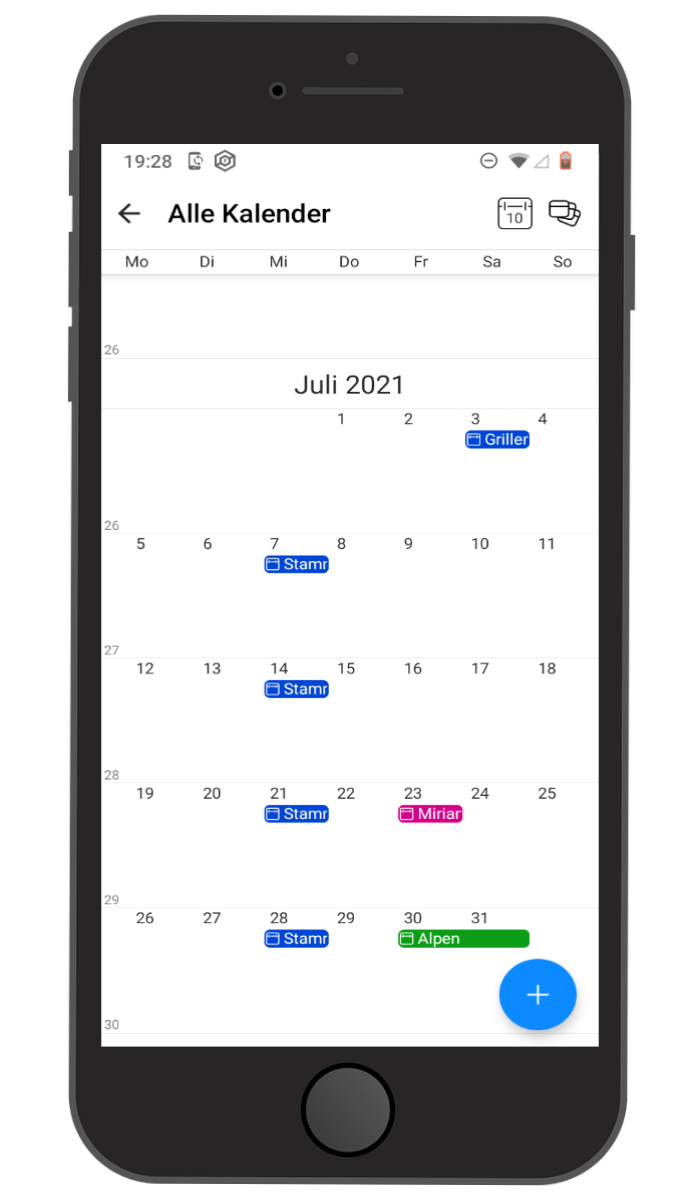
GroupCal is at its best when a group is already connected by phone numbers — small sports teams, families, friend groups, ad-hoc squads without a fixed IT stack. The SMS or link invite path is genuinely easy, the iOS app looks polished, and the ability to share existing calendars (Google, iCloud, Outlook) into GroupCal without copying events is a smart trick.
Public Channels with web embeds can work for hobby clubs that want to publish a season schedule on their website — provided the budget is there.
Where it falls short for clubs and teams
As soon as a friend group becomes a real organization, GroupCal starts hitting walls:
- 255-member cap per calendar. Too small for mid-sized to large clubs. Channels on Business+ are unlimited but one-way only — not a shared editing calendar.
- Only 1 admin on Free and Pro; 3 admins on Business ($50/mo). A board plus a few section leads can’t share admin duties on the affordable plans.
- Phone-number sign-up required. Landline support only starts on Business. Older members, kids without their own phones, or anyone reluctant to share their personal number face a real barrier.
- Ads on the free tier, plus device IDs shared with ad partners per the privacy policy.
- Calendar only: no threaded chat, no pinboard, no documents, no member directory, no dues management.
GroupCal and GDPR
Israel has an EU adequacy decision, so transferring personal data to 24me itself is on stable footing. The thornier issues are in the details:
- The privacy policy explicitly allows transferring personal data to non-EU third countries without naming a specific transfer mechanism.
- A standard DPA / processor agreement isn’t visible on the affordable tiers; “custom legal reviews” are mentioned only at the Enterprise level (from ~$750/mo).
- The free tier monetizes via personalized advertising based on device identifiers.
For a club processing member data, this means: without a signed processor agreement on the affordable tiers, the GDPR story is hard to defend.
Alternatives to GroupCal
If you like the phonebook-style invite charm but bump against member limits or pricing, the usual next stops are:
- TimeTree — similar idea, different pricing structure, member limit of 500. See our TimeTree review for clubs.
- Club-focused apps that bundle calendar with member management. Overview: the 17 best apps for your club.
Klubraum as a German alternative
If you want a dependable group calendar for your club without member caps, SMS sign-up, ads, or a fuzzy GDPR story, take a look at Klubraum. Hosted in Germany with a DPA, multiple admin roles, and a group calendar built for club structures — plus a free base tier that doesn’t track or monetize you.
Bottom line
GroupCal has evolved from a slim family calendar in 2019 into a tiered SaaS platform. That’s good for many users — the app today is meaningfully more capable than it used to be. But for clubs the tier and member caps fill up fast: 255 members per calendar, a single admin on the cheap plans, and no publicly documented DPA make GroupCal a fit for small phonebook-style groups, but rarely for a whole organization.