
Last reviewed: May 2026.
Kalender.digital is a refreshingly unflashy member of the shared-calendar field — and one of the very few with a German operator, German data hosting, and an honest club focus. If you’re looking for a calendar that’s easy to embed on a club website and just-works for members without an app install, it’s probably already on your shortlist. Here’s what it delivers in 2026, what it costs, and where it runs out of road.
Table of Contents
- What is Kalender.digital?
- Features and pricing at a glance
- Where Kalender.digital shines
- Where it runs out of road
- Kalender.digital and GDPR
- Alternatives to Kalender.digital
- Bottom line
What is Kalender.digital?
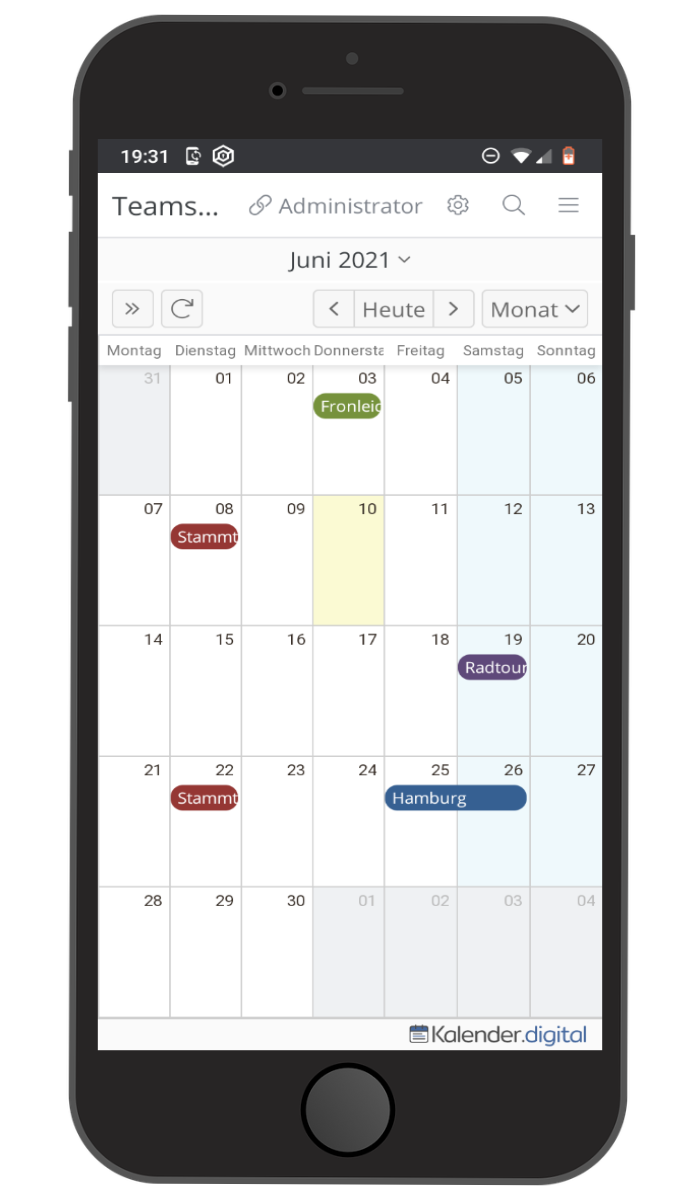
Kalender.digital is a shared web calendar from Kalender.digital GmbH, based in Düsseldorf, Germany, launched in 2019. The defining idea: a calendar without user accounts. Access is controlled by share link, with three roles (Administrator, Editor, Reader). The calendar embeds on any website and exports via iCal into other calendar apps.
The product targets clubs, families, schools, and churches, with notable corporate customers as well. An international sister product has existed since 2020 under the name Calendar.online — same engine, English-first marketing.
Features and pricing at a glance
- Platforms: web (browser, all devices) plus native apps for iOS, iPadOS, macOS, and Android.
- Pricing (as of May 2026, per calendar — subject to change; check Kalender.digital for current rates):
- Basic: €0 — up to 6 sub-calendars, 3 access links, 1 year of history.
- Plus: €6.90/month (or ~€5.52/month annually — 20% off) — 20 sub-calendars, 10 access links, email reminders, file attachments, custom branding, 5 years of history.
- Premium: €14.90/month (or ~€11.92/month annually) — unlimited sub-calendars, unlimited access links, SMS reminders, API, custom logo, website embed, unlimited history.
- Users per plan: unlimited — pricing is per calendar, not per member.
- Features: sub-calendars with colors, login-free link access with roles, iCal import/export, email reminders (Plus) and SMS reminders (Premium), Calendly-style appointment booking, website embed (Premium), regional holidays for DE/AT/CH, PDF and Excel export.
Where Kalender.digital shines
The biggest strength is the low onboarding hurdle: anyone who has the link can view or edit the calendar, depending on their role — no account, no app, no setup. For small clubs that want to publish events and a fixture list on their website without making everyone install something, it’s about the most frictionless option around.
The GDPR story is solid: a German operator, German servers, anonymized IP storage, and a clear stance against third-party data sharing. If you’ve ever had to wrestle with a US-vendor DPA, you know the value.
The booking function is a nice extra — small clubs can offer coaching slots, hall bookings, or office hours Calendly-style without paying for a second tool.
Where it runs out of road
Kalender.digital is — by the operator’s own framing — primarily a calendar. That has consequences:
- No real member management. Roles live on the link, not on an identity. A change on the board usually means rotating links.
- No group chat, no pinboard, no tasks. If you want more than “when is what happening?”, you’ll need a second tool.
- Per-calendar pricing instead of an organization licence. With several department or sub-calendars on their own paid plans, costs can climb quickly. A single Premium plan covering everything is possible but won’t fit every structure.
- Recurring rules are limited — complex patterns (“last Saturday of the month”) get flagged in reviews.
- No push notifications beyond reminders — short-notice communication still happens on WhatsApp.
Kalender.digital and GDPR
This is where Kalender.digital outshines its peers. Hosted in Germany, operated by a German GmbH, IP addresses stored only anonymized, and an explicit pledge that data is not shared with third parties. GDPR compliance is openly advertised.
Whether a standard Data Processing Agreement is included in every tier or available on request isn’t fully documented on the public site — but among the five calendar tools in this comparison series, this is the least problematic on the legal side.
Alternatives to Kalender.digital
If you want more than just a calendar, you typically end up looking at:
- TimeTree or GroupCal — mobile, app-first group calendars with per-event chat. See TimeTree for clubs and GroupCal for clubs.
- Club-specific platforms that bundle calendar, communication, and management. Overview: the 17 best apps for your club.
Klubraum as an addition, not a competitor
If you’ve been using Kalender.digital purely as a website calendar and now want chat, a pinboard, departments, tasks, and push notifications in one app, take a look at Klubraum. Klubraum brings a group calendar plus everything else that happens around club life into a single mobile and web app — also on German servers, also with a DPA, and with a free base tier that has no ads.
Bottom line
Kalender.digital is an honest, well-designed solution for clubs that want to nail one job: a website-friendly, login-free, GDPR-clean shared calendar. German hosting and the role-per-link model are real wins.
But if you want to digitize more than events — communication, members, departments, tasks — a club app will serve you better overall. Running both in parallel is possible; long-term, it’s rarely the comfortable path.